

Tuesday, March 8, 2011

Tuesday, February 22, 2011
Jamey Aebersold Teaches the World to Swing

This is the first thing I wrote for Midwest Jazz after my semi-traumatic move from Minneapolis to Buffalo.
After the editor encouraged me to keep my ears open for worthy stories to tell, I pitched a piece on Jamey Aebersold. While Jamey is recognized today as a pioneer and titan of jazz education — indeed, 20 years after this was published the National Endowment for the Arts awarded him the title of Jazz Master, its highest award in the field — back then the mainstream jazz publications more or less ignored him. This would be the first published in-depth treatment of him I’m aware of.
We had an interesting and wide-ranging conversation for this piece: he had surprising things to say about the state of jazz education (comments still entirely relevant today) and how he’d changed things for better and for worse, along with tidbits about how he came up with his groundbreaking play-along concept, what his expectations were at the beginning, and the behind-the-scenes process that goes into his sets.
Reprinted with permission from
Midwest Jazz Fall 1994 (Vol. 1, #3),
an Arts Midwest publication.
Jamey Aebersold is not a jazz vocalist. Not really. And yet in a “blindfold test” literally thousands of jazz musicians would call out his name upon hearing him intone, in his no-nonsense Indiana twang, “One. Two. One, two, three....”
That’s because “Jamey Aebersold” is a household name — if your household happens to harbor an aspiring jazz musician.
He is heard counting off the tempos on more than 60 volumes comprising his trailblazing play-along series, A New Approach To Jazz Improvisation. These recordings form the cornerstone of many serious jazz musicians’ practice regimens.
Each set features a CD or cassette (and once upon a time, LP) recording of a rhythm section (usually piano-bass-drums, although guitar or Hammond B3 organ are featured on some) and a coordinated booklet with transposed parts for all instruments (the piano’s in the right channel of the stereo recording, with the bass in the left, so players of those instruments can turn down the appropriate channel).
Thanks to the series, even the most isolated would-be jazzer has the opportunity to play with such luminaries as pianists Mulgrew Miller, Kenny Barron, Patrice Rushen, Richie Beirach, Hal Galper, Ronnie Mathews, Harold Mabern, James Williams, and Jim McNeely; bassists Ron Carter, Rufus Reid, Bob Cranshaw, and Ray Drummond; and drummers Ben Riley, Al Foster, Louis Hayes, Billy Hart, Grady Tate, Adam Nussbaum, Mickey Roker, and Marvin Smitty Smith. Among others.
The approach is simple and effective for developing fluency in the hundreds of tunes that make up the lingua franca of the jazz musician. In addition to numerous sets featuring all manner of standards in various styles, there are also sets devoted to the compositions of notable jazz innovators and composers: Duke Ellington, Thelonious Monk, Charlie Parker, Miles Davis, John Coltrane, Sonny Rollins, Horace Silver, Woody Shaw, Wayne Shorter, Benny Golson, Cedar Walton — the list goes on and on. Other sets cover the building blocks of the jazz vocabulary, including the blues and the ii-V-I chord progression.
Jamey Aebersold started out as a saxophonist, earning his Masters Degree from the University of Indiana in the early ’60s. Since then, thanks to his stellar work in the field, he was voted into the Hall of Fame of the International Association of Jazz Educators, and he received an Honorary Doctorate of Music from Indiana University in 1992. He’s even been seen on the CBS television program “Sunday Morning,” on a segment about jazz education that featured his Summer Jazz Workshops, which bring players of all levels together with a heavy faculty of recording musicians and educators. The workshops have been held not only in the U.S. and Canada, but in Australia, New Zealand, Germany, England, Scotland, and Denmark as well.
 When I was in college, I thought that the last thing I would be was an educator.Aebersold got into the play-along business more or less by accident. “Back in the ’60s, I was at a big band camp in Connecticut. At the end of the week, I had a private lesson with a couple of saxophonists — I was playing piano, walking a bass line with the left hand and playing chords with the right. When we were finished, they asked me if I would make a tape for them of blues and standards, things like There Will Never Be Another You and Green Dolphin Street, a few choruses of each. Well, I never got around to making the tape for them, but I did come out with Volume One a year or so later.”
At first Aebersold didn’t expect much, and wasn’t even planning to go beyond the first volume. “I really thought the Berklee School of Music would take it over, if they considered it a good idea. I could imagine a series: a Duke Ellington set, a Count Basie set, and so on. They never did take it on, so a couple of years later I added a few more sets, and before long people were saying ‘hey, why don’t you do this,’ and we were off and running. At the time, I still considered it a sideline rather than my main thing. But then it got out of hand!”
He’s currently working on Volumes 62, 63, and 64, which will focus on trumpeter Tom Harrell, guitarist Wes Montgomery, and salsa & latin jazz. “I want to do one of Christmas songs this year too!”
Aebersold’s business, which not only sells his own materials but also hundreds of other jazz instruction books and videos, is based in his home in New Albany, Indiana. Nowadays the typical play-along recording session takes place right in his basement. “I put the drummer in one room, the bass player in the next, each one with headphones and their own little amplifier for volume control, and I’m in the office here with the piano and the tape recorder.
“I sit at my desk, and I fix the tempo with a metronome, letting them hear it through the mic. Then I count it off and let them go. After four, five, or five and a half minutes, I say ‘OK, last chorus, take it out,’ very softly into the mic.”
In the early days of the series, Aebersold played sax along with the rhythm section, in a separate booth, to keep things tight (the sax track, of course, was not included in the final mix). “Now, from time to time, if the piano player worries about getting too repetitive, or feels like he’s starting to solo rather than accompany, I’ll scat-sing softly into the mic. That levels everything out again.”
Aebersold takes care to ensure that the arrangements and changes for the tunes on the sets are definitive. “We talk about the beginnings and endings before we start. Some of the fake books that I’ve seen don’t have very good changes, so I’m always careful about our changes, and want them to be correct. When you’re dealing with people of the caliber of (jazz educator) Dan Haerle or Hal Galper, well, they don’t want to play changes that aren’t the way jazz players play them, so they’ll speak up — ‘Jamey, you don’t want a dominant 7th chord there, shouldn’t that be minor’ — that sort of thing. We make those adjustments, but I tell you, sometimes it’s a toss-up, and I’ll have to run and pull out the classic recordings, and we’ll strain to hear what those guys are playing, and all the while the clock’s ticking away....”
The old days were better in some ways, because people were forced to use their ears & really listen.The way jazz knowledge is passed on has changed considerably over the years. Novice jazz musicians used to advance through what amounted to an apprenticeship system, learning the music by sitting in with accomplished mentors. Jam sessions were the classrooms in the music’s previous periods.Today jam sessions of that sort are hard to come by, and the apprenticeship system has largely been supplanted by academic approaches. Most of the musicians currently rising through the ranks typically go through high school and college jazz programs, referring to numerous jazz improvisation texts along the way. Aebersold, a key figure in today’s jazz education scene, laments some aspects of how that scene has changed.
We oftentimes have players who don’t get lost & play the right notes, but aren’t saying much.“I think the old days were better in some ways, because people were forced to use their ears and really listen. Jazz education has changed, and of course I’m a part of that too. Now people use books, a visual medium — people using their eyes instead of their ears. They’re taking the information in on the left side of the brain, while the right side, the creative side, isn’t being used the way it used to. When I was coming up, the eyes weren’t important, the ears were — listening was key. The right side took in the information, while the left side, the analytical side, tried to figure out what was going on. Now, it’s almost reversed, and I think we oftentimes have players who don’t get lost and play the right notes, but aren’t saying much.“I’m sorry that things have changed in that respect. We have many people today attempting to learn how to improvise, which I think is marvelous, but in my opinion the importance of listening isn’t stressed enough.”
Aebersold believes that improvisation should be a core value in school music curriculums, as a key to developing the students’ creativity, and that music contests have hurt rather than helped the cause. In an article entitled “Music Is For Life” he writes:
We’ve taken the students’ freedom to play music and forced them into a competitive mode. They play a few songs, over and over, to be performed at a competition, festival, or contest in hopes of winning a trophy... What if math or English were taught that way?... I can’t picture a high school History teacher working his students over and over on the Gettysburg address for three months to bring home a first place at contest.
Aebersold favors creativity over competition. “I think that if everyone were given a chance to develop their creative side, the world would be a lot more peaceful. Having a creative outlet is very important, and music is a tremendous stress reliever.”
His sets have helped thousands develop their own creative resources. Yet Jamey Aebersold downplays his status as one of our premier jazz educators. “When I was in college, I thought that the last thing I would be was an educator. When I got started with the series, I took it step by step, not pushing myself into it at all. In fact, all along the way I was thinking, ‘tomorrow, instead of worrying about all this play-along stuff, I’m going to practice three hours. Tomorrow’s the day.’ Now, that day hasn’t come yet, but I’ve had a lot of fun along the way.”
UPDATE: As you might expect, a few things have changed in the nearly 2 decades since this piece first came out...
- “more than 60 volumes” — as I write this, Jamey has more than doubled that number!
- “Each set features a CD or cassette (and once upon a time, LP)”: a few cassettes or LPs are still available, as signed collector’s items...
- “Volume One, Jazz: How To Play & Improvise, is available today in English, German, French, and Japanese.” — add Spanish and Portuguese to the list...
- “I want to do one of Christmas songs this year too!” — It took a little longer than that: the first volume of Christmas tunes was Volume 78.
Sunday, February 20, 2011
John Coltrane • “Take The Coltrane” transcription
 From the Impulse! recording Duke Ellington & John Coltrane, recorded September 26, 1962.
John Coltrane
Take The Coltrane transcriptionThis is an amazing blues performance from John Coltrane’s celebrated meeting with Duke Ellington. Around the time of this recording, many in the jazz press, including some usually perceptive and open-minded writers, couldn’t “hear” Trane: they found his sound harsh and his lines angular, unswinging, and abstract. Meanwhile, some lesser writers cursed his output as anti-jazz, angry noise that threatened to eclipse and even destroy real jazz.
♫ MP3 ♫
Coltrane’s solo on
Take The ColtraneBob Thiele, the head of Coltrane’s new label, Impulse!, astutely decided to counter the bad press by positioning his new artist as a player firmly in jazz’s mainstream, first by getting the Duke’s “seal of approval” in a collaboration, followed by an ear-friendly album of ballads.
Coltrane’s solo on Take The Coltrane, an Ellington riff penned for the occasion, is a yin-yang study in tension and release: knotty dissonant phrases are juxtaposed with bright, sing-songy consonant motives. The tension he creates with this approach is unsettling, like watching an artist paint swatches of cheerful primary colors onto a smoldering canvas about to burst into flames. (Ellington lays out during the solo, giving Coltrane room to air out his ideas.)
Harmonically, Trane uses a few regular strategies to move from dissonance to consonance, always with an ear toward making strong resolutions at the “big spots” in the form: in the last 4 bars of the chorus, he might play outside the changes entirely, and then firmly resolve into the harmony again to lead into the next chorus. Here are examples from mm. 69-73 and 92-97:


He’ll sometimes make a false- or mini-resolution to the C7 in bar 5 of the form using the same technique; here’s mm. 149-151:

More typically at bars 3 & 4 in the form he’ll play a tritone substitution resolving into bar 5; here’s an example from his 2nd chorus (see also choruses 3, 4, & 8):

Trane’s forays outside of tonality seem more dissonant and intense because they are often resolved by simple and unambiguous diatonic motives, like this very consonant “triad-pairesque” line from his 2nd chorus:

Whatever Coltrane is up to, here’s the thing: this solo is a blast to play! From a technical standpoint it’s actually simpler and more approachable than many of Trane’s outings — there are no sheets of sound here, no intensely technical passages that defy normal, mortal fingers! If you’ve ever worked on a Trane solo and thought to yourself “I’ll never be able to play this...,” here’s one, as amazing and deep as it is, that might actually be coaxed from your horn after a bit of shedding...
(A note about the chord changes in this transcription: these are intended more to delineate the form and provide a possible context for Trane’s blowing. These changes do not always reflect Garrison’s bass lines, and do not even necessarily reflect Trane’s actual intentions: the blues is an incredibly fluid and flexible framework for blowing, and Trane was a master at pushing its limits even further! In several cases here there are multiple ways to interpret the harmonic context of his lines; the changes on this transcription provide one viable and hopefully straightforward interpretation...)
Don't have this classic, must-have recording? You can get it from Amazon in the following formats:
Instant MP3 Download of the track Take The Coltrane
Instant MP3 Download of the album Duke Ellington & John Coltrane
CD of the album Duke Ellington & John Coltrane
Your purchase from Amazon helps to support this blog!
Instant MP3 Download of the track Take The Coltrane
Instant MP3 Download of the album Duke Ellington & John Coltrane
CD of the album Duke Ellington & John Coltrane
Your purchase from Amazon helps to support this blog!
Monday, February 14, 2011
Exactly One Year Ago Today: Epic Gig Shots!
 Bar La Vigne, Briancon, France: early in the morning of February 14, 2010
 Jazz Club Torino, Torino, Italy: late in the evening of February 14, 2010
Tuesday, February 8, 2011
Dexter Gordon • “There Will Never Be Another You” transcription
 From the Black Lion recording Body & Soul, recorded July 20, 1967.
Dexter Gordon
There Will Never Be Another You transcriptionThere’s no law requiring bars 3 and 4 of There Will Never Be Another You to be a minor ii-V (Em7b5 to A7b9 in tenor key) leading into the minor 7 chord in bar 5. If there were, Dexter would be risking jail time and a fine in this performance, as he frequently (but not always!) plays these changes as Em7 to A7 (or Em9 to A9).
♫ MP3 ♫
Gordon’s solo on
There Will Never Be Another YouIt’s not a trivial difference! To ears accustomed to the traditional, way-it’s-always-done, God-ordained “normal” progression for this tune, the onslaught of F#s and B naturals sounding in these two bars comes off as some sort of ear-cleansing, hip and “out there” substitution. But nope, it ain’t: it’s just a wholesome ol’ plain-as-pie ii-V, but without the “traditional” half-diminished and flat-nine spicing.
Related Posts
You, Personally, Are Playing There Will Never Be Another You Wrong
John Gilmore & Clifford Jordan
Status Quo transcription (“There Will Never Be Another You” changes)
Here we have 8+ choruses of how-it’s-done-boys-and-girls bebop improvisation over one of the most common tunes called on a jazz gig. What more is there to say? Horn in your hand? On your mark, get set...
Wait! Actually, there is a bit more to say about some of what Dexter’s up to here:
- First off, regarding the aforementioned bars 3 and 4 (and 19 and 20) of every chorus: okay, I’m overstating the earth-shatteringitudiness of Dex’s major ii-Vs here, but that’s because the first time I heard it years ago it totally threw me for a loop — especially that spot at measure 115 where he anticipates the Em7 by repeating a bunch of F#s over the FMaj7 chord: that was the moment my head exploded (I'm an active listener...). So, when playing this tune, I will sometimes use this gambit, and it always makes the piano player raise his head with a start, as if someone spilled a drink in his lap. “Made you look!”
- Dexter has this little “embellishment thingy” (I'm appropriating this term from the Harvard Dictionary of Music, if memory serves...) he does very regularly to add some propulsion and excitement to the start of his lines (and sometimes within the line), and I’m sure there’s got to be an actual moniker for it, but ... I have no idea what that might be. It’s sort of like an unprepared escape tone — which is more or less a self-negating nonsense coinage, so if you know a better “official” term, you MUST provide it in a comment.
It’s easier to just show the goldarn thingy than to describe it: note the beginning of his lines at the end of measure 10 leading into 11, 193 into 194, 253 into 254, 258 into 259; and at measures 25, 200, 233, 261, and 298. He hits a note and instantly jumps down from it and continues his line. The hell’s that called? Whatever, he does it so much here it becomes almost a sort of tic — once you start listening for it, you’ll spot it all over the place. - Dexter was known for his verbal witticisms (“In nuclear war all men are cremated equal”) and for his musical witticisms, inserting clever, unexpected musical quotes into his phrases as a sort of “aural wink” at the listener. Jazz educator Jerry Coker has lamented that this is a dying art: we’re losing the lingua franca of musical “stuff” — snippets of standards or bugle calls or cartoon themes or other bits of musical doggerel — that provided material for quotemeisters like Dexter and Sonny Rollins, so that this or that amusing quote goes right over the heads of younger players.
And: he’s right!
But, at the same time, I suspect younger players will go about finding their own relevant material: I’ll never forget hearing a 16-year-old James Carter (it was 1985) blowing over a now-forgotten standard (“Rainy Day,” maybe...), suddenly interjecting the sax riff from a hit of the moment, Glenn Frey’s “The Heat Is On”! It was utterly unexpected, it was glorious, and ... it had exactly the effect Dexter’s ingenious quotes must have had at their moment of expression. Kids’ll figure out their own stuff to do...
This particular Dexter solo actually strikes me as restrained quote-wise, compared to some of his other performances. A few are unambiguous: “I’ll Never Be The Same” at 4:42 (thanks to an anonymous email correspondent for making that great catch!); the old Dixieland warhorse “Dinah” sounds at 9:45 (a tip of the hat to John Greiner — a very fine saxophonist from my hometown! — for putting the name on that one...); the sort-of-calypso tune “Marianne” (“All day, all night, Marianne”) pops up from nowhere at 10:23; and: what else? That’s “Laura” at 3:28, right? Might 4:20 be a bit of Ellington’s “Rockin’ In Rhythm”? Is 11:01 sort of “Satin Doll”? Folks from the Sax On The Web discussion group, where I tossed out an All-Call to see what else could be spotted here, detected the possible traces of a number of other tunes. Were they conscious quotes on Dexter’s part, or just evocative melodic fragments, faces in the clouds? Don’t know, and unfortunately Dexter isn’t around to tell us.
But: we do have this wonderful performance! Here, Ladies and Gentlemen, is how a Master would play There Will Never Be Another You.
Don't have the recording? You can get it from Amazon in the following formats:
Instant MP3 Download of the album Body & Soul
CD of the album Body & Soul
Your purchase from Amazon helps to support this blog!
Instant MP3 Download of the album Body & Soul
CD of the album Body & Soul
Your purchase from Amazon helps to support this blog!
Saturday, January 29, 2011
John Coltrane
• “Satellite” transcription
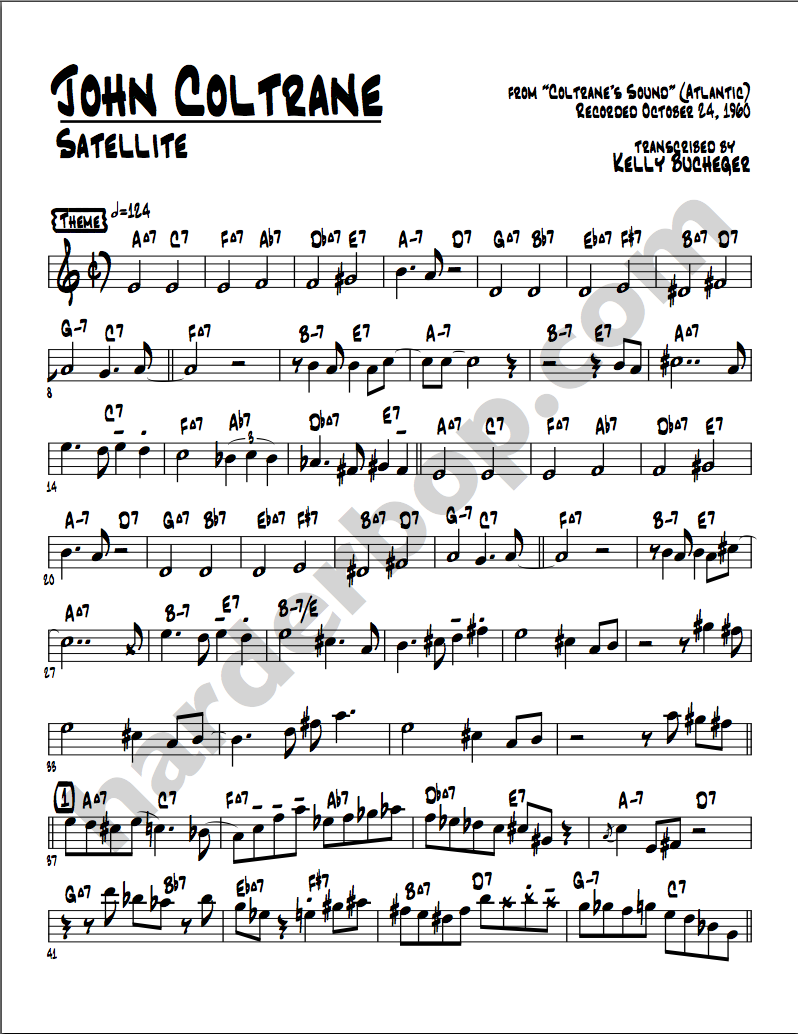 From the Atlantic recording Coltrane’s Sound, recorded October 24, 1960.
John Coltrane
Satellite transcriptionIn February of 1959, at a recording session in Chicago featuring the sidemen of the Miles Davis Sextet, John Coltrane used a novel harmonic approach while soloing on the old jazz chestnut Limehouse Blues. This was the first recorded instance of “Coltrane changes.” Instead of obediently marching through the circle of fifths in the manner of most jazz standards, Coltrane's chord progression/substitution scheme featured the exotic sound of descending major 3rd root movements.
About two months after that Chicago session, Coltrane was in New York laying down the first exploratory tracks for what would become a showcase for his new harmonic discoveries, the album Giant Steps. That album put Trane changes front and center, displaying his rigorous and even astonishing mastery of them. (These changes require serious shedding to “get under the fingers” — in fact, none of the work from that first day appeared on the album, in part because the rest of the group, seasoned pros like Cedar Walton, were having difficulties with the harmonic minefield presented by the new progression.)
In a way, Coltrane’s work on Giant Steps represented a logical (and even extreme) culmination of the implications of “vertical” (harmonic, change-based) improvisation, an approach that seemed especially well-suited to Coltrane’s technical command of his horn.
Amazingly, in the same months he was working on Giant Steps, Coltrane was recording an album with Miles Davis that featured another new harmonic approach — an approach that amounted to nearly a rejection of vertical improvisation!
Kind of Blue was a modal jazz “shot heard ’round the world” among jazz musicians. On So What, the album’s opening track, one chord is played over the first 16 bars, a nearly absurdly static harmonic pace compared to the typical jazz standard or bebop tune of the day — or, especially, compared to Coltrane’s Giant Steps, where 26 chords come and go in the same number of bars.
The modal approach of Kind of Blue represented a milestone in “horizontal” (melodic) improvisation, and highlighted Davis’s strengths as an improviser in the same way that Giant Steps highlighted Coltrane’s.
And yet, Coltrane met the challenge of Kind of Blue beautifully. His solos, sweeping, urgent and lyrical, are excellent foils for Davis’s much sparser but no less compelling statements. But nowhere on Kind of Blue does Coltrane use Trane changes!
While his near-simultaneous work on Giant Steps means that during the Kind of Blue sessions Coltrane undoubtedly had his new harmonic scheme on his mind and under his fingers, and while Limehouse Blues shows that he'd already explored superimposing his changes over standard progressions, Coltrane apparently felt unsure of how to apply his new approach to Davis's new modal music.
Over the next few years, however, Coltrane would entirely modify his tactics in modal improvisation, integrating his vertical harmonic discoveries into the horizontal melodic framework of modal tunes. His live version of Impressions, a contrafact over the changes of So What recorded almost three years later, is shatteringly different from his work on Kind of Blue.
In the time between the two recordings, Coltrane had learned to superimpose Trane changes (among other things) over modal material.
Which brings me to Satellite, where the kinder, gentler chord progression of How High the Moon is gutted and tricked out with Coltrane changes. I’ve always considered this tune, recorded in October 1960 (about a year and a half after the last of the Giant Steps and Kind of Blue sessions) to be a sort of “missing link” between the Trane of Giant Steps and the “pan-modal” Trane of Impressions.
That’s because each chorus of the tune features an 8-bar modal stretch of B-7/E where Trane reveals some of his new thinking on how to blow over static harmony. This is most striking in the lengthy tag that concludes the tune — over an extended vamp on the sus chord, Coltrane explores several novel ways to approach modal improvisation, including the superimposition of Trane changes and some nearly outside playing. It’s a precursor to the approach he’d later use on tunes like Impressions.
(In a future post or two I’ll put up some Trane changes lines derived from this solo, and some further thoughts on how Coltrane plays over the modal parts of this tune. In the meantime, here’s Satellite! Get shedding, ’cuz this stuff’s going to be on the test!)
Don't have the recording? You can get it from Amazon in the following formats:
Instant MP3 Download of the track Satellite
Instant MP3 Download of the album Coltrane's Sound
CD of the album Coltrane’s Sound
Your purchase from Amazon helps to support this blog!
Instant MP3 Download of the track Satellite
Instant MP3 Download of the album Coltrane's Sound
CD of the album Coltrane’s Sound
Your purchase from Amazon helps to support this blog!
Thursday, January 20, 2011
Dick Oatts • “Master Class Demonstration: Bird Blues in (Almost!) 12 Keys” transcription
 (Because this is not a commercially available recording, but is instead a "bootleg" of a master class, I'm providing an MP3 of it — Please see the NOTE at the end of this post.)
♫ MP3
Dick Oatts
Plays Bird Blues
recordingThis is a master class performance by Dick Oatts, showing what it means to REALLY be able to get around on your horn in all 12 keys. I've heard that in the class Oatts says something to the effect that he's not reallyPDF
Dick Oatts
Plays Bird Blues
transcription trying to be creative here — he's demonstrating how it sounds to have no technical limitations in any key. To illustrate this degree of fluidity, he improvises over Bird blues changes (à la "Blues for Alice"), starting in D and modulating at the end of every 12-bar chorus through the circle of fifths: G, C, F, etc.
And: it's breathtaking! In just over 2 minutes Oatts spins out an impromptu etude that aspiring jazz saxophonists (and players of all instruments) at any level can pore over and shed for a good long time.
If you want to start slow, you could treat it as a sort of "Bird Blues meets Klose" exercise, maybe play a key a day, getting each 12-bar chorus up to speed, then later chaining the whole damn thing together. That alone would keep keep you off the streets for a while.
Then, you could start to mine the many beautiful ii-V and ii-V-I patterns to be found here, grabbing the ones that really appeal to you and shedding them in all 12 keys. You could also spend quality time studying Oatts' use of approach and escape tones, the unexpected way he anticipates and delays resolutions. It's beautiful, inspiring stuff. And that's just getting started.
Basically, these five pages can provide practice room fodder for literally weeks and months...
Before you get going, a few things to mention:
- This isn't quite Bird Blues in all 12 keys: as he's finishing the chorus in E, Oatts doesn't turn around as expected into A, the only remaining unplayed key — instead, he modulates into the starting key of D, then abruptly breaks off. I'm guessing this is not because he's afraid of blues in A (heh!) — was he perhaps given a signal that time was short and he needed to wrap things up?
- Any jazz solo transcription contains, AT BEST, 50% of the "data" that makes a solo beautiful and swinging: the notes and rhythms are just the bare bones of a great solo. For example, Dick Oatts is a master of saxophone articulation — he has many ways of playing, sorta playing, not playing, finessing, accenting, implying, stabbing, schmearing, and faking out any given note. This gives his lines a "signature" kind of forward momentum and swing feel that is very recognizable as "Dick Oatts" — AND, it's impossible to notate using any music notation system that would be accessible and readable.
So, while I've noted some of the "bigger picture" accents and staccatos, the vast majority of wholesome goodness that makes his playing so very compelling is ... not on the page! - His "ghost" notes in particular pose challenges that haunt (I apologize for that...) the potential transcriber. Ghost notes are typically notated using an "x" for the notehead, and you'll spot them throughout this transcription. Ghosting notes is sort of the opposite of accenting them: the note is swallowed or played quietly or almost just implied rather than stated unambiguously like the notes surrounding it. It's a common jazz technique, but Oatts takes it to a whole 'nother level: many of his ghosted notes don't even ... EXIST!
I'm an experienced transcriber, but I've never encountered so many instances where I can unmistakably hear the note, but then when I slow the track down and check it very carefully, there is ABSOFRICKINLUTELY NOTHING THERE! There's a hole where a note seems to be clearly audible at regular speed.
There are several instances here where, listening to the performance at speed, the note is ... there, and I'm required by the Transcribers Guild to write it down. Slow the track way down, however, and ... note go bye-bye in car. (It's like it's some sort of ghost or something!) The Transcribers Guild doesn't cover this kind of hocus pocus, dammit — so I'm gonna write down the ding-dang note, but show that it's ghosted. Listen for this and you'll hopefully hear what I'm talking about.
That's enough. Get to work!
NOTE: Usually I provide an Amazon link to the solo I'm transcribing. If you don't have the recording, a solo transcription is best used for wrapping fish — however, for just 99¢ each you can download from Amazon many of the tracks I've transcribed in this blog, making these transcriptions genuinely useful! You can also download entire albums, or buy CDs. This whole 21st century thing is turning out to be pretty cool.
However, for the first time in this blog, I'm providing an MP3 of the recording, because it's a bootleg and otherwise you're not going to be able to find it. But maybe I could propose a deal: if you find this track great and cool and interesting, and don't really know Dick Oatts' playing (and if you only know his [outstanding!] big band work, you don't really know his playing), then howzabout you buy a Dick Oatts CD?
I'm surprised more jazz fans don't know Dick Oatts' great quartet and quintet recordings. And in fact, I'm afraid to say it, but if you're a serious jazz alto student and haven't heard much Dick Oatts, there's a fairly good chance you might be ... a loser.
So: buy Standard Issue, Volume 1, as a CD, featured to the left, or as an MP3 download.
 Oh My God what a great CD!!! I've played it so much the laser in my CD player has burned out all the pits in the disc, so now when I put it on it's just silence. (But, because it's a CD, it's PERFECT silence...) Or buy All Of Three as an MP3 download.
 Holy Carp! (There's so much more: check out his other Steeplechase stuff, like for example Saxology, the quartet with Bergonzi, as an MP3 download!
 Just typing about it makes my fingers tremble!)
If you're a saxophonist and Dick Oatts is relatively new to you, you've got some catching up to do...
Friday, January 14, 2011
Sonny Rollins • “St. Thomas” transcription
 From the Prestige recording Saxophone Colossus, recorded June 22, 1956.
Sonny Rollins
St. Thomas transcriptionPrestige released Sonny Rollins' album Saxophone Colossus in 1956. "Colossus" is defined as "a person or thing of enormous size, importance, or ability" — therefore, I can say definitively that the album was titled with absolutely no hyperbole at all: this collection of three originals and two standards represented the pinnacle of jazz performance at that moment, and Rollins, 25 years old at the time of the recording, was indisputably The Titan of the tenor saxophone.
And yet: what always strikes me whenever I revisit this music (and I have heard it many hundreds of times without tiring of it), is how joyful, how playful (and, I will concede, devastating, in the case of You Don't Know What Love Is) this amazing recording remains.
Without a doubt it's "serious" music: Rollins displays a no-nonsense, formidable mastery of his horn and his material, and his sidemen were among the top practitioners of the art at the time.
But Saxophone Colossus, in spite of that imposing name, was also very approachable: while jazz scholars (amazingly, a few existed back then, with Gunther Schuller leading the pack here) held up Rollins' work on the album as worthy of dissertations on the art of "thematic improvisation," casual listeners could just ... dig it.
(Jazz musicians, and tenor players in particular, could not hear this album in any "casual" way, however: this was heavy music that merited study and inspired serious woodshedding. If there had been any question as to the Top Dog in the tenor world — and Rollins before this point was already a leading contender for the title — Saxophone Colossus laid to rest any doubts.)
St. Thomas is a "calypso" tune that Rollins said wasn't so much an original as it was an arrangement of a well-known Caribbean melody reflecting his familial roots in the Virgin Islands. Since its first airing here, this simple tune, whatever its origins, has become a jam session staple: it's been played, misplayed, overplayed, flayed, flambéed and julienne-fried nearly to death — so much so that it's hard to imagine that once upon a time it was: fresh, new, unusual, hip!
However, this first recording in the history of the world of St. Thomas, played by the Colossus and his mates, still sounds fresh, new, unusual, hip to my jaded 21st-century ears! As Good As Jazz Gets. And since any aspiring jazz musician sooner or later will be required, by New York State Law, to jam their own wobbly and unsteady path over these changes (with the expectation that you'll improve over time, dammit, or else don't come back), you might as well study this First, Seminal version of the thing to get a head start.
While you listen to it, and work to play along with it, I hope you feel (seriously!) joy — because that's what I felt when I first heard it, what I felt when I first started getting it under my fingers, and what I still feel when I hear this recording today! It's a great feeling. Good luck, have fun! And thank you, Sonny, forever!
Don't have the recording? You can get it from Amazon in the following formats:
Instant MP3 Download of the track St. Thomas
Instant MP3 Download of the album Saxophone Colossus
CD of the album Saxophone Colossus
Your purchase from Amazon helps to support this blog!
Instant MP3 Download of the track St. Thomas
Instant MP3 Download of the album Saxophone Colossus
CD of the album Saxophone Colossus
Your purchase from Amazon helps to support this blog!
Wednesday, January 12, 2011
John Gilmore & Clifford Jordan • “Status Quo” transcription
 From the Blue Note recording Blowing In From Chicago, recorded March 3, 1957.
John Gilmore &
Clifford Jordan
Status Quo transcriptionBlowing In From Chicago paired two journeyman tenor players, Clifford Jordan and John Gilmore, early in their careers. Both came out of the storied "Chicago school" of big-toned tenor men — fellow "classmates" include Gene Ammons, Johnny Griffin, and Von Freeman.
♫ MP3 ♫
Gilmore & Jordan’s solos on
Status QuoJordan would later distinguish himself with notables like Max Roach and Cedar Walton. For me, his work with Mingus is a high point, and his intense and even spine-tingling blowing on Right Now: Live At The Jazz Workshop makes that recording a "desert island" pick for me. (I also think he's unfairly overlooked as a composer — his fine hard bop tunes are as worthy of revisiting as Hank Mobley's stuff.)
Gilmore is best known, of course, for his work with Sun Ra, and it's often said that John Coltrane regarded him highly and even took some lessons from him.
Related PostGilmore blows first on this track, Status Quo (based on the changes to There Will Never Be Another You), and it's interesting to hear him at this very early point in his career (Blowin' In From Chicago was his first recording as leader — as it was for co-leader Jordan): unlike the interplanetary voyages he would later undertake with Sun Ra, his playing here consists instead of fine bread-and-butter bebop lines that are well-executed but entirely earthbound.
Jordan follows Gilmore, with a bigger sound and more than a hint of Dexter Gordon in tone and time feel. While his lines differ from Gilmore's, they're also strictly from the bebop playbook.
This transcription offers idiomatic straight-ahead bebop vocabulary from two young players who had this stuff fully under their fingers, and who'd go on to develop distinct and compelling voices of their own.
If you dig the sound clip, you'll love the entire recording of this hard bop classic! You can get it from Amazon in the following formats:
Instant MP3 Download of the track Status Quo
Instant MP3 Download of the album Blowing In From Chicago
CD of the album Blowing in From Chicago
Your purchase from Amazon helps to support this blog!
Instant MP3 Download of the track Status Quo
Instant MP3 Download of the album Blowing In From Chicago
CD of the album Blowing in From Chicago
Your purchase from Amazon helps to support this blog!
Thursday, January 6, 2011
Kenny Garrett • Human Nature (from “Miles In Paris”) transcription
 From the Warner Bros. DVD Miles In Paris, recorded 1990.
Kenny Garrett Human Nature transcriptionThis Kenny Garrett solo, from the Miles In Paris DVD recorded in 1990, has become a YouTube (and Daily Motion) classic (there's a link at the end of this post), for good reason: first of all, Kenny plays beautifully here, offering a fine demonstration of how to build a solo over a single-chord vamp. It also doesn't hurt that there's some extra-musical drama afoot in the performance: Kenny's clip-on mic wasn't working, and he's seen signaling the problem to Miles. Miles beckons him to center stage anyways, having him play into Miles' own clip-on mic, still attached to his trumpet. And that trumpet, of course, is being held by the Prince of Darkness himself: Miles becomes the funkiest and most intimidating damn mic stand you've ever seen. (It's right at this point, at the beginning of Kenny's solo, where most of the YouTubes pick up the action, but it's worth catching the whole thing on DVD...)
Garrett plays, during these unusual circumstances, inches away from Miles and his inscrutable gaze, without any apparent hesitation or ill effect, as if he and Miles do this kind of weird Miles-all-up-in-your-face shit all the time. (Who knows: maybe they did? Or maybe by the time you get to the level of playing with Miles, you're beyond intimidation.) His solo is masterful and worthy of some serious study — it's all about time-feel and articulation and harmonic resourcefulness and rhythm and building tension.
(By the way, it's also worth searching on YouTube for the Miles in Warsaw 1988 concert — if it's available commercially, I haven't found it. On that version of Human Nature, Kenny's mic is working fine. Miles, freed from his role as human mic stand, ventures to his keyboard to occasionally jab some off-the-wall, say what? chord into the mix. Kenny responds to Miles' unpredictable harmonic provocations with a solo that ventures much further "out there," into more bracing harmonic turf than he explores here, in this later outing in Paris...)
A few comments on what Kenny does here:
- He gets a lot of mileage out of the F# minor pentatonic scale (F# A B C# E), as you might expect over an F# minor vamp. Although he certainly goes far beyond this scale (see below), sometimes he'll really settle into the minor pentatonic tonality for a bit — so that when he finally breaks from it, as when he hits the D# in measure 29, it's almost shocking and refreshing — even though D# is a consonant note in this context.
- His side-slipping* scale of choice is a half-step BELOW the tonality — in other words, he'll typically slot into F minor (and occasionally F7) to systematically go out, then pop back into F# minor for that refreshing ah!-moment release of tension. Examples abound, but mm. 11 and 91 are especially clear on this front.
This was surprising to me, as my "default" side-slipping approach is typically to go a half-step ABOVE the tonality. This is probably getting pretty jazz-nerdy, and I apologize for that, but going below, as Kenny does here, is "outer" and cooler. Here's why: playing a half-step above the tonality (G minor or G7 here) can harmonically imply that you're playing the tritone substitution of the V7 chord (C#7 would be the V7 chord here; G7 the tritone sub, of course), one of the most venerable and common harmonic gambits in a jazz player's toolkit. So the listener might perceive that and "validate" it within that context.
However, playing down a half-step does not imply any typical and "valid" harmonic approach, so there's no "safe" way for a listener to hear it and categorize it. It's just ... out! And therefore, the resolution is perhaps even more satisfying.
(*If you'd indeed even consider this side-slipping: a fellow poster on the Sax On The Web board didn't — he thought this was just garden-variety "takin' it out." If anybody has an opinion on this, I'd love to hear it, since "side-slipping" isn't an entirely codified term. Or is it? Anybody with further insight in this, feel free to comment!)
- Check out how "exotic" and hip the MAJOR 3rd sounds over this minor vamp, around m. 17. It would normally be considered, what?, not viable? naughty? Whatever, it can be a very hip sound — but it has to be handled carefully. Garrett typically "prepares" and "resolves" this otherwise very dissonant sound by surrounding it with the minor 3rd. The minor 3rds become a sort of lead canister to contain the "radioactive" major 3rd. The minor 3rds are the tongs used to safely handle the boiling beaker containing the major 3rd. The minor 3rds are the Hazmat suit that permits handling the corrosive major 3rd.
To put it another way: the overextended metaphor is employed by the look-at-me-writing-something author here to explain a straightforward concept.
- So, howzabout that D harmonic minor tonality starting at m. 54? Where did THAT come from? Whatever, it sounds really cool, and you should rip this off. People "in the know" might nod...
- I dig how when Kenny starts doing that rhythmic shtick on the A, starting around m. 60 (both here and in the altissimo tremolos he does toward the end, the "alternate As" are achieved by putting down the right hand D, E, and F keys, while fingering A in the left), he STOPS doing it right at the point where folks start hollering. And lest you think it's just a cheap trick, remember that it is Kenny's faultlessly hip groove and articulation that make this cool.
Don't have the recording? You can get it from Amazon in the following formats:
DVD of Miles In Paris
Your purchase from Amazon helps to support this blog!
DVD of Miles In Paris
Your purchase from Amazon helps to support this blog!
Tuesday, January 4, 2011
Dexter Gordon • “It’s You Or No One” transcription
 From the Blue Note recording Doin’ Allright, recorded May 6, 1961.
Dexter Gordon
It's You Or No One
transcriptionDoin’ Allright was a comeback album for Dexter Gordon, who'd more or less vanished from the scene for nearly a decade, a result of what the jazz press euphemistically called "personal problems." It marked the beginning of a long and fruitful association with Blue Note, and although Dex was soon to leave the U.S. for what he hoped would be greener pastures in Europe, the Blue Note recordings quickly reaffirmed his place among the greatest hard bop saxophonists.
It’s You Or No One features all of Dexter’s strengths: his robust sound, his back-of-the-beat time feel, along with what might be considered to be totally "in the pocket," perfect bop lines (sometimes nearly too perfect, perhaps: measures 31-34 and 63-66 are identical!).
Don't have the recording? You can get it from Amazon in the following formats:
Instant MP3 Download of the track It's You Or No One
Instant MP3 Download of the album Doin' Allright
CD of the album Doin' Allright
Your purchase from Amazon helps to support this blog!
Instant MP3 Download of the track It's You Or No One
Instant MP3 Download of the album Doin' Allright
CD of the album Doin' Allright
Your purchase from Amazon helps to support this blog!
Sonny Rollins • “Striver’s Row” transcription
 From the Blue Note recording A Night At The Village Vanguard, recorded November 3, 1957.
Sonny Rollins
Striver's Row
transcriptionSonny Rollins is no friend of the recording studio. He's said that the stressful, artificial recording environment stifles his creativity. And while he's released many wonderful studio recordings regardless of his discomfort, it's often said that catching him live on a good night is an unsurpassed, amazing experience.
(I've heard him live on several occasions, and was always inspired. Without a doubt, however, the most terrifying time was in 1980 in Warsaw, at Jazz Jamboree '80, in a standing-room-only, to-hell-with-fire-codes crowd in the massive Congress Hall. I — seriously! — thought there might be a riot when the "authorities" decided it was time to end the concert. There are some YouTubes about from that gig, and I hope to write more about it sometime...)
Rollins connoisseurs have long considered the pianoless trio to be the perfect Rollins unit: with no piano to dictate a harmonic direction, Sonny is free to explore every nook & cranny of a chord progression.
A Night At The Village Vanguard, the first live recording ever done there (for later jazz artists, their own live VV recording would become a sort of badge of honor) combines the best of both worlds: a good live recording of Sonny in a trio. And among an entire album of gems, Striver’s Row, an impromptu meandering through the changes of Confirmation, is a masterpiece. Rollins tosses off knotty, impossible lines with a casual virtuosity that should terrify other tenor players.
Don't have the recording? You can get it from Amazon in the following formats:
Instant MP3 Download of the track Striver's Row
Instant MP3 Download of the album A Night At The Village Vanguard CD of the album Night At The Village Vanguard
Your purchase from Amazon helps to support this blog!
Instant MP3 Download of the track Striver's Row
Instant MP3 Download of the album A Night At The Village Vanguard
CD of the album Night At The Village VanguardYour purchase from Amazon helps to support this blog!
Saturday, January 1, 2011
My Jazz Highlights of 2010 #5:
John Escreet (with David Binney) breaks my brain in Toronto
 I heard this group over 2 days at the Rex in Toronto, where I spent the Thanksgiving holiday with Deb. I didn't know John Escreet, but wanted to hear David Binney live. He killed (as expected), but what really surprised me was Escreet and his stunning compositions, layered and knotty and dark, calling to mind folks ranging from George Crumb to Cecil Taylor. I've been studying scores from his recording Don't Fight the Inevitable (available on his website) since attending these performances, to better understand how he got a quintet to do that stuff, and I'll be pondering his music, and being thrilled by it, throughout 2011 and beyond...
My Jazz Highlights of 2010 #4:
Recording with Harder Bop & Bruce Johnstone
We've had one recording session so far, in November 2010, at the studios of the Eastman School of Music in Rochester, and I expect we'll do a couple more in the coming months. I'll have more to say about this as we get further into the project, but for now I'll just note that I never would have dreamed, as a high school saxophonist who revered Bruce Johnstone and had memorized his solos with Maynard Ferguson's band back in the '70s, that I'd ever record with him. On hearing this news, my friend Tom Stansell probably most eloquently expressed my own excitement at the prospect: "BRUCE F**KIN* JOHNSTONE?????????? That's incredible!"

Kelly Bucheger, Bruce Johnstone, Tim Clarke

Kelly Bucheger, Bruce Johnstone, Tim Clarke
My Jazz Highlights of 2010 #3:
Harder Bop plays Jazz@Unity Of Buffalo
 Harder Bop is a hybrid group of some of my usual collaborators from What Would Mingus Do?, trumpeter Tim Clarke and pianist Michael McNeill, along with a couple of younger up-and-coming monsters: bassist Danny Ziemann, currently studying at Eastman, and drummer Russ Algera.
Like WWMD, Harder Bop plays my tunes. There's some overlap between the two groups in terms of personnel and even repertoire, but if I were forced to differentiate the two, I'd propose that What Would Mingus Do? is more hard-bop oriented while Harder Bop is perhaps a bit more likely to incorporate funk and free influences...
♫
Dharma Brats
Jazz@Unity, Buffalo
October 3, 2010
Jazz@Unity Of Buffalo, a performance series created by Michael McNeill, is a welcome new jazz venue in Buffalo. I'm honored to have performed my music as part of this series, and I look forward to seeing where Michael's considerable creativity takes Jazz@Unity.

Danny Ziemann, Russ Algera, Michael McNeill, Kelly Bucheger, Tim Clarke
Subscribe to:
Posts (Atom)